I’m reactivating the newsletter since I am finally NOT writing a textbook. The newsletter has over 500 subscribers, so I’m moving it to Substack on the advice of the incomparable Dr. Janet Salmons. Substack also allows video and sound. The newsletter helps me to
· address questions I do not have time to answer at webinars
· offer information about qualitative research that I am frequently asked about (e.g., compensation)
· disseminate open resources to offset the high cost of textbooks for much of the global world.
· connect the qualitative research community to ethical, legitimate sources in a time where we are bombarded with unscrupulous research ploys
· feature the incredible qualitative researchers I have the privilege to engage with
The Qualitative Research Facebook & YouTube
The group has grown to over 47,100 members with a wide global reach! I’m grateful for all of Dr. Carlene Brown’s work that keeps the group growing. Use the QR code to join.
I created a fledgling YouTube channel for the group. Facebook Live has been made difficult to negotiate, so the group’s webinar is held on Zoom and posted to youTube and Facebook.
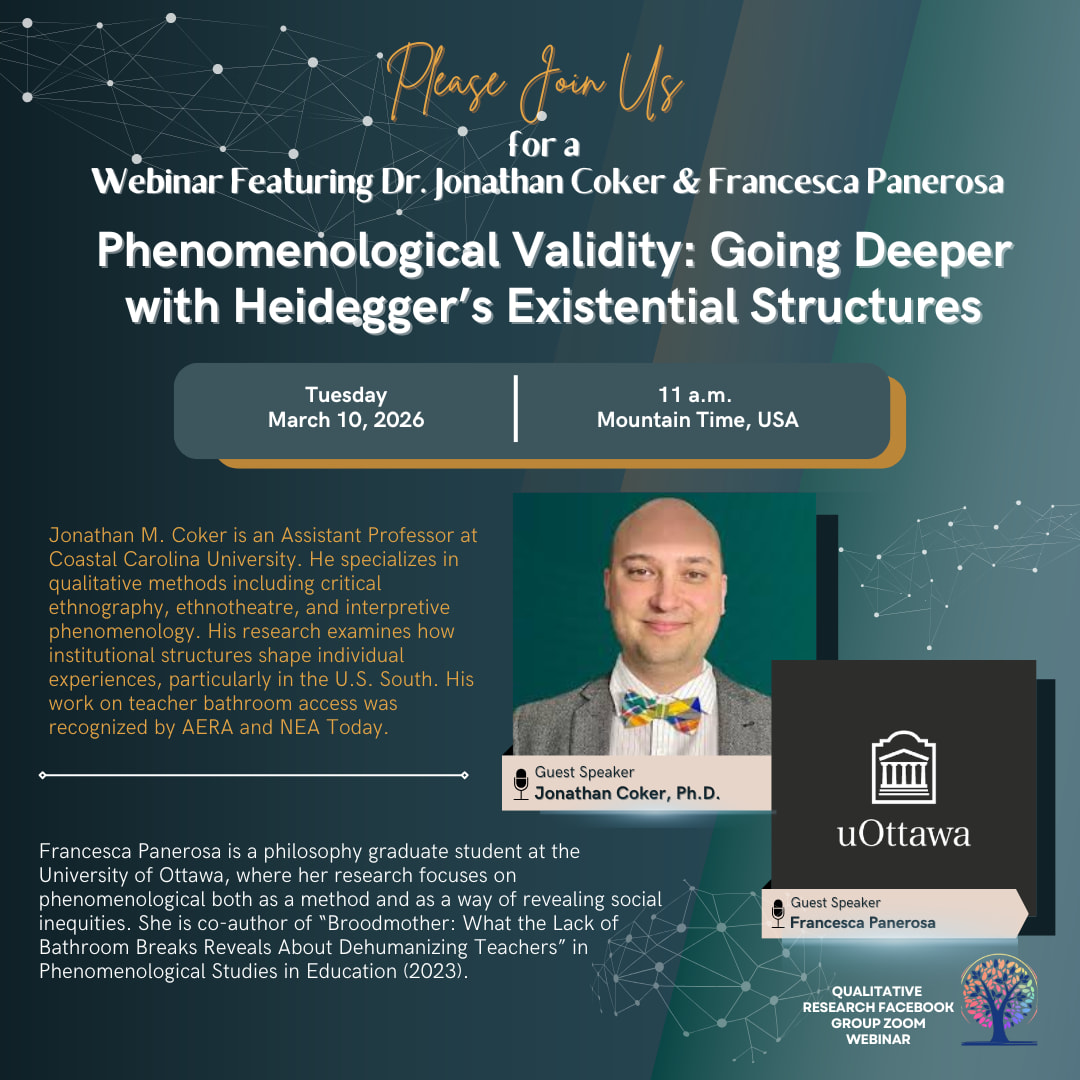
For the March webinar, Phenomenological Validity: Going Deeper with Heidegger’s Existential Structures we are excited to welcome Dr. Jonathan Coker and Francesca Panerosa for a rich and engaging conversation on phenomenological validity and what it truly means to work deeply with Heidegger’s existential structures in qualitative research. In this webinar, they explore: • What phenomenological validity means beyond surface-level description • How Heidegger’s existential structures inform interpretive analysis • The relationship between lived experience, institutional life, and qualitative inquiry • Ways researchers can move toward deeper, more philosophically grounded analysis
Whether you are new to phenomenology or looking to deepen your interpretive practice, this session promises thoughtful discussion and practical insight for qualitative researchers.
We hope you will join us for what will be a meaningful and intellectually engaging conversation.
Zoom link: Use the time converter to see when the event is happening where you are: https://www.timeanddate.com/worldclock/converter.html?iso=20260310T170000&p1=75
Incentive Coercion Compensation PInK?: Who, What, When, Why & How
The question of whether—and how—to compensate research participants continues to spark debate. With websites named Guinea Pigs Get Paid (GPGP) and online ads asking“Interested in finding a paid research study on Craigslist? You are not alone.” These simple lines capture the tension: people need money, and researchers need participants, and participants are people, not animals. But what does this mean ethically?
Some argue that offering payment risks pushing people—especially those who are economically insecure—into studies they might otherwise avoid. As critics note, participants may “be encouraged to be in studies they would not be otherwise or even take risk… they would not normally” (Lahman, 2018). Others worry that routine compensation erodes the spirit of altruism that has long shaped research participation.
At the same time, many disciplines treat compensation as standard practice. Discussions typically focus on fairness and structure, including models such as minimum‑wage remuneration, reimbursement for expenses, and risk‑based compensation.
Global money context must also be considered. What is a little money to a researcher might be a lot at a global level. With online recruitment, this issue is heightened.
Youth research introduces an added layer. As one team notes, “an amount of financial compensation that may not be a significant incentive with adults, may border on coercion with children and youth.” And yet, studies show that adolescents may agree to research—even risky research—without any payment at all, complicating assumptions about inducement.
Researchers also vary in when they disclose compensation: some give gift cards immediately when a youth joins a study, “would know they did not need to continue the study,” while others withhold compensation details until the end, so it functions more as a thank‑you than an incentive.
The debate intensifies around people experiencing homelessness. Some REBs caution that “homeless subjects are vulnerable to coercion… [so] compensation should not be offered.” But as Tyler Kincaid, PhD, counters, “That is no different than saying, ‘don’t give spare change.’” The concern for undue influence is real—yet so is the risk of paternalism.
Across all of these perspectives, one thing is clear: there is no consensus. Compensation remains a deeply contextual ethical decision, demanding that we stay reflective, culturally responsive, and attentive to the realities of people’s lives (Lahman, 2018).
Compensation is paying research participants for their time. Considerations here will be around how much to pay and include the time they take to participate in member checking or commuting to a study site. Some researchers suggest paying minimum wage.
Reimbursement is when the researcher pays the participant for expenses they have incurred, such as subway fare, a parking fee, or childcare.
Payment-in-Kind (PInK) occurs when a research participant is given payment through a non-monetary item, such as groceries or the researcher’s time.
A thank you occurs after a study is over or at points during a more extended study. This is not used as an incentive but as a way for a researcher to express appreciation. In a study where I was in the field for two years, I periodically brought the teacher a coffee I knew she enjoyed and wrote seasonal thank-you notes to her. The critical point here is that simple, natural ways of thanking someone do not come under the purview of the REB.
General Tips
· All researchers should thank the research participants, whether it is a simple email of thanks to many participants or a handwritten thank-you note to someone who has hosted you on their site for the research.
· A thank-you gift that is not used as an incentive is not under the purview of an REB. Consider a small gift as you leave a research site.
· If a research participant is from a low-income group, if at all possible, compensate them at the higher end of the minimum hourly wage.
· Novice and early career researchers doing unfunded research should save compensation if possible until their first formal research studies (e.g., dissertation) or if (I hope not) they cannot find research participants.
· Payment-in-Kind of your time to help at a research site can be invaluable both for your understanding as a researcher and for the site members you are researching. (Lahman, 2025, p. 232).
References
Lahman, M. K. E. (2025). An introduction to qualitative research: Becoming culturally responsive. SAGE.
Lahman, M. K. E. (2018). Ethics in social science research: Becoming culturally responsive. SAGE.
Research Ethics
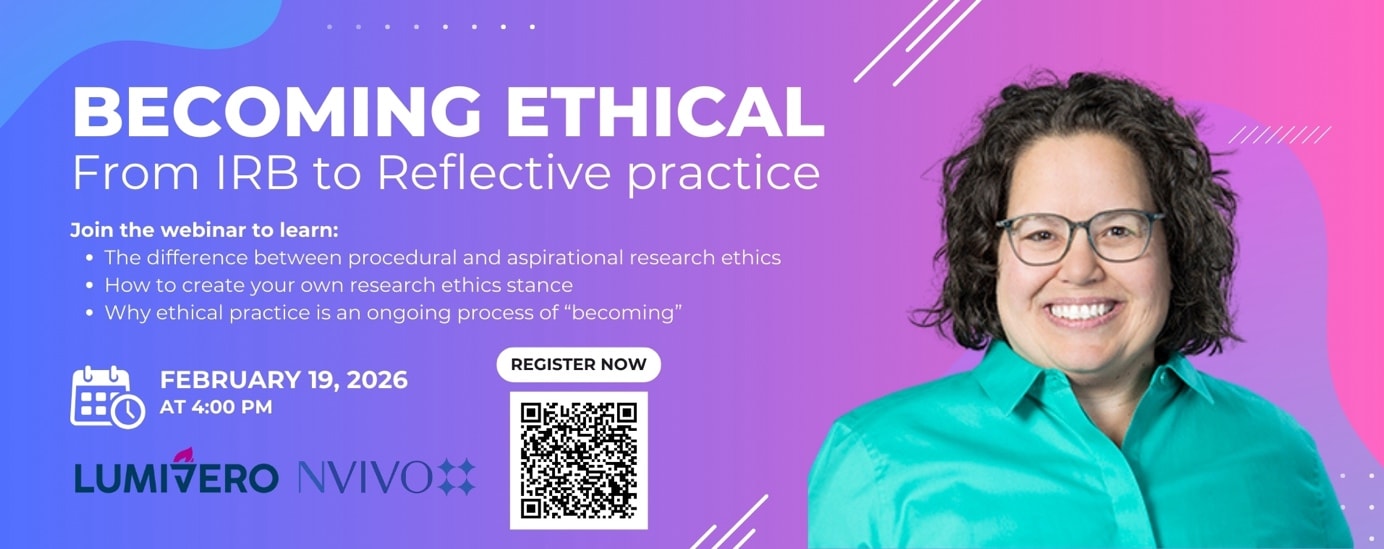
Check out the webinar Becoming Ethical I had the privilege to give with Lumivero (NVIVO). I am answering questions from it that I did not have time to address both in the newsletter and on my website and the Facebook Group.
Please consider sending the QR code for this newsletter to anyone you think would be interested in subscribing.
A BIG THANKS to Teagan Fortune for her help with the process of creating this newsletter.
Qualitative Research is Better with Community!
Thanks for reading! Subscribe for free to receive new posts and support my work.
Share this blog post
We use cookies on our website to give you the most relevant experience by remembering your preferences and repeat visits. By clicking “Accept”, you consent to the use of ALL the cookies.
This website uses cookies to improve your experience while you navigate through the website. Out of these, the cookies that are categorized as necessary are stored on your browser as they are essential for the working of basic functionalities of the website. We also use third-party cookies that help us analyze and understand how you use this website. These cookies will be stored in your browser only with your consent. You also have the option to opt-out of these cookies. But opting out of some of these cookies may affect your browsing experience.
Necessary cookies are absolutely essential for the website to function properly. These cookies ensure basic functionalities and security features of the website, anonymously.
Cookie
Duration
Description
cookielawinfo-checkbox-analytics
11 months
This cookie is set by GDPR Cookie Consent plugin. The cookie is used to store the user consent for the cookies in the category "Analytics".
cookielawinfo-checkbox-functional
11 months
The cookie is set by GDPR cookie consent to record the user consent for the cookies in the category "Functional".
cookielawinfo-checkbox-necessary
11 months
This cookie is set by GDPR Cookie Consent plugin. The cookies is used to store the user consent for the cookies in the category "Necessary".
cookielawinfo-checkbox-others
11 months
This cookie is set by GDPR Cookie Consent plugin. The cookie is used to store the user consent for the cookies in the category "Other.
cookielawinfo-checkbox-performance
11 months
This cookie is set by GDPR Cookie Consent plugin. The cookie is used to store the user consent for the cookies in the category "Performance".
viewed_cookie_policy
11 months
The cookie is set by the GDPR Cookie Consent plugin and is used to store whether or not user has consented to the use of cookies. It does not store any personal data.
Functional cookies help to perform certain functionalities like sharing the content of the website on social media platforms, collect feedbacks, and other third-party features.
Performance cookies are used to understand and analyze the key performance indexes of the website which helps in delivering a better user experience for the visitors.
Analytical cookies are used to understand how visitors interact with the website. These cookies help provide information on metrics the number of visitors, bounce rate, traffic source, etc.
Advertisement cookies are used to provide visitors with relevant ads and marketing campaigns. These cookies track visitors across websites and collect information to provide customized ads.